
If you’ve spent any time online lately, you’ve likely seen the headlines: AI is coming for every job. It’s natural to wonder: “If a computer can calculate my retirement projections in seconds, will AI replace my financial advisor?”
The short answer is no. In fact, in a world where generic financial advice is becoming a commodity, specialized human expertise is becoming more valuable, not less.
The Power of the Niche: Expertise AI Can’t Download
AI is trained on the entire internet, but it hasn’t spent decades sitting across the table from people exactly like you. We specialize exclusively in serving clients aged 50 and older who are getting ready to retire.
Because we focus only on this stage of life, we’ve seen the same patterns play out dozens of times. We know that most retirees share the same 5–10 core goals and concerns. This isn’t knowledge documented in a database; it’s expertise built from years of focused experience. We know exactly which attorney, which insurance specialist, and which tax preparer to connect you with for your specific situation. We know what concerns will keep you up at night before they even occur to you.
Discovering Your Why
AI is a “Yes Man.” It answers the questions you ask, but if you don’t ask the right questions, it will give you the wrong advice. It can’t help you discover your “Why.”
Our job is to ask the questions you haven’t thought of yet! An algorithm can calculate a savings rate, but it doesn’t understand your history with money, your fears, or how to navigate a difficult retirement talk with your spouse. AI solves for the math; we solve for the person.
The Danger of Authoritative Errors
One of the biggest risks of using AI today is its confidence. AI is notoriously unreliable when it comes to specific tax advice or complex numerical analysis. It sounds authoritative and correct even when it is completely wrong.
In the high-stakes world of retirement taxes, “mostly right” is a disaster. We provide objective, specific advice that is in your best interest. Sometimes that means telling you what you need to hear, rather than just the answer you want to hear.
The “Trust Penalty” and the Human Touch
Industry leader Michael Kitces often speaks about the “Trust Penalty.” When the markets drop 20%, you don’t want a chatbot with a spreadsheet. You want a partner who can look you in the eye and say, “We planned for this.”
Humans are biologically wired to want another person “at the wheel” when their life savings are on the line. Think about what actually builds trust:
- Sitting across the table from one another.
- Showing up for the big milestones.
- Shaking a hand and being called by your name.
That’s old-school, and it’s the future. In a world where every interaction is increasingly digital and automated, physical touchpoints and real relationships stand out precisely because they are rare.
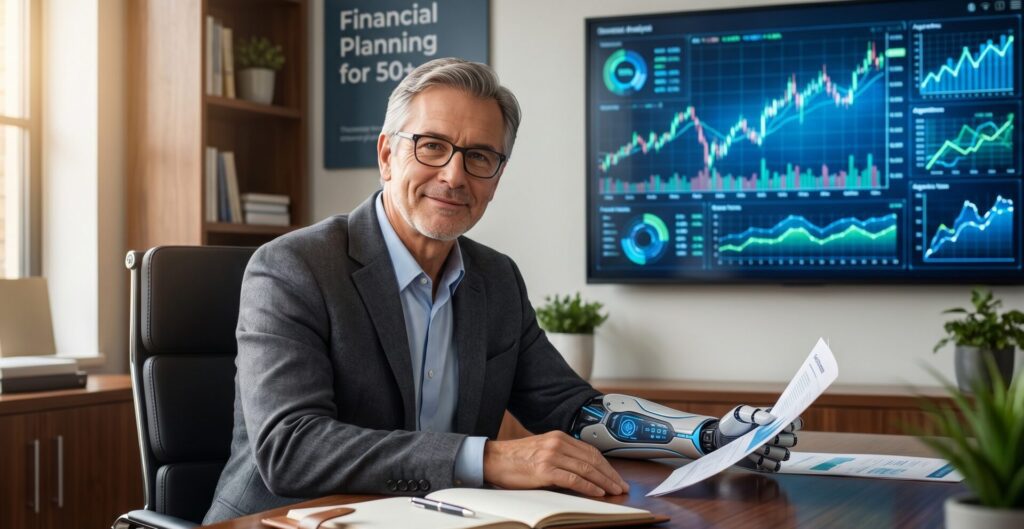
The “Cyborg” Advisor: The Best of Both Worlds
This doesn’t mean we ignore technology. As Kitces suggests, the most effective advisors are “cyborgs.” We use AI to do the “heavy lifting”—the mechanical calculations, meeting notes, and data extraction—so we can focus on the uniquely human aspects of money and emotion. Money is rarely just about numbers; it’s about fear, legacy, and family dynamics.
As Dan Haylett explores in “The Empathy Delusion,” advisors who only offer generic “friendliness” are at risk. The real value is in behavioral strategy—managing the gap between what a client should do and what they actually do. AI can give you the map, but it can’t make you walk the path when the weather gets rough.
The Bottom Line
AI is a tool for the DIYer who wants to spend their retirement managing spreadsheets. But if you want a professional who knows your story, anticipates your needs, and provides a steady hand when the world feels uncertain, you want a human.
AI can solve the math, but it can’t share the journey. And for those entering their best years, the latter is what truly matters.
“Airplanes have had incredible autopilots for decades, but would you board a flight that didn’t have a human pilot in the cockpit for when things get turbulent?